Archives

  • Meros
    Vol. 8 No. 2 (2025)

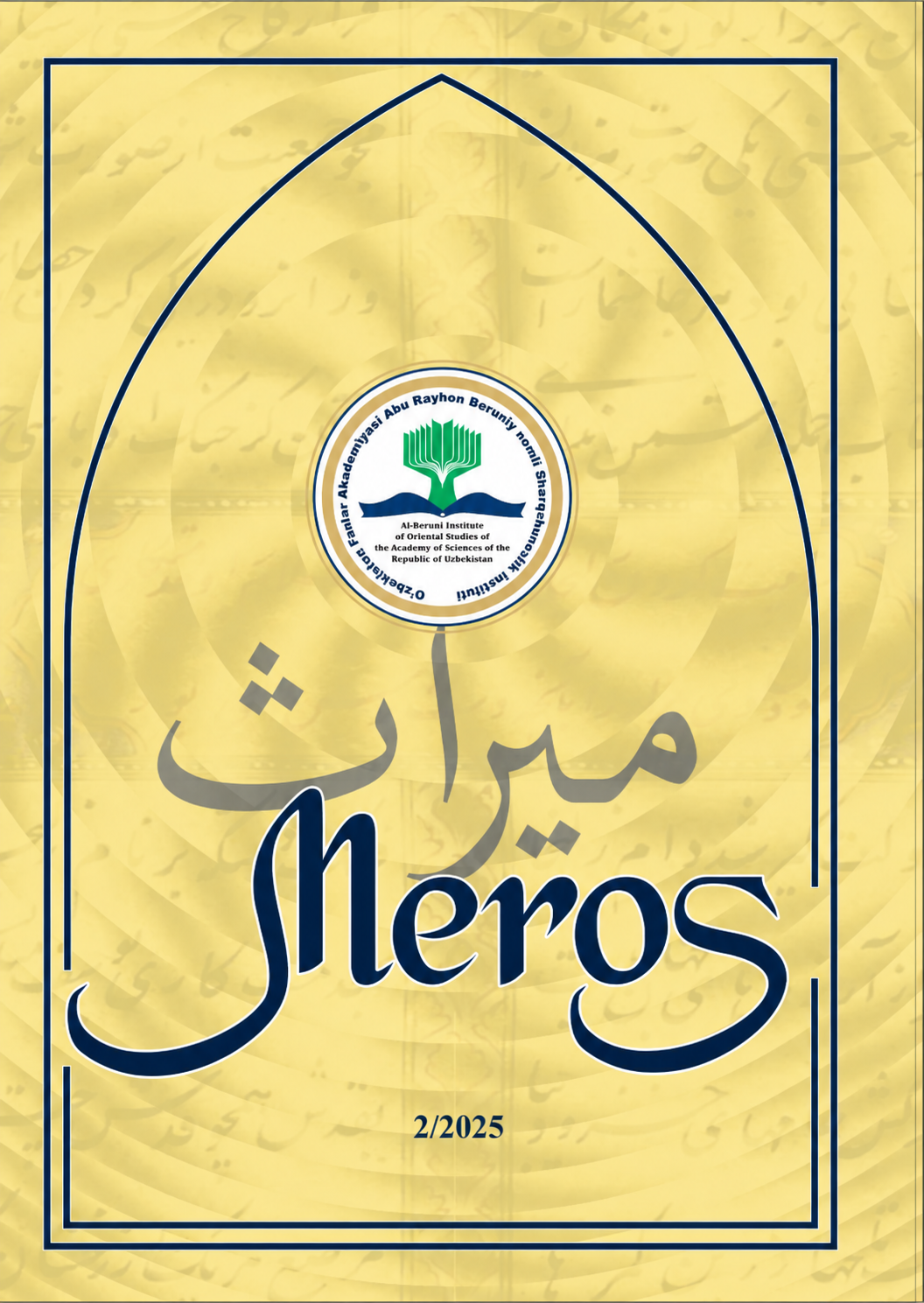
    “Meros” is a scholarly journal dedicated to research in Oriental studies, source studies, history, historiography, literature, and international relations. The journal is published by the Abu Rayhan Beruni Institute of Oriental Studies of the Academy of Sciences of the Republic of Uzbekistan.

    Issue No. 2 (2025) of the journal features scholarly articles organized into four thematic sections: “Source Studies,” “History and Historiography,” “Literature,” and “International Relations.” This issue presents academic research on the study of manuscript sources, the examination of historical processes, the analysis of literary heritage, and the history of international relations.

  • Meros
    Vol. 9 No. 1 (2026)

    Meros. 2026, Issue 1 (Volume 9, Number 1) An academic journal published by the Al-Beruni Institute of Oriental Studies, Academy of Sciences of Uzbekistan. This issue presents research in source studies, historiography, history of science and culture, Islamic studies, and philology. Articles include analysis of Chinese written sources on diplomatic relations of Amir Timur’s empire, Soviet historiography on Timur’s governance, Ibn Sina’s medical legacy, and discussions on religious tolerance in Sufi thought.

  • Meros
    Vol. 7 No. 2 (2024)

    Issue 2 (2024) of the Meros journal is a special commemorative volume dedicated to the 85th anniversary of Professor Ashraf Akhmedov, bringing together scholarly contributions in Oriental studies, source studies, and the history of science and culture.

    The issue features research focused on the intellectual legacy of Abu Rayhan Beruni and his scientific school, medieval Islamic science, mathematical and astronomical traditions, and the development of scientific thought in Central Asia. It also includes studies on the works of al-Khwarizmi, al-Farghani, and Ulugh Beg, as well as manuscript culture, textual criticism, and translation studies examined through modern methodological approaches.

    By integrating source-based analysis with interdisciplinary perspectives, this volume represents a significant academic contribution that highlights continuity in scholarly traditions and serves as a valuable platform for the international research community.

  • Meros
    Vol. 7 No. 1 (2024)

    Meros is a scholarly journal devoted to Oriental studies, source studies, history, historiography, and cultural heritage research. It is published by the Al-Biruni Institute of Oriental Studies, Uzbekistan Academy of Sciences. Issue 1 of 2024 brings together academic articles in the fields of source studies, history and historiography, document studies, Islamic studies, history of science and culture, literary studies, and foreign Eastern affairs.

    The issue places particular emphasis on the manuscript heritage of the East, the works of Abu Rayhan Beruni, the historical geography of Central Asia, Jadidism, Turkic documentary heritage, religious and textual traditions, literary textual studies, and the socio-economic and historical processes of contemporary Eastern countries. The table of contents includes studies on manuscript copies of Beruni’s Tafhim, legal formularies from Abu Hafs al-Nasafi’s encyclopedia, data on the historical geography of Central Asia in Shuyuy Zhouzylu, theoretical views related to the “Turk” ethnographic group, Jadid reflections on the role of newspapers in the Fergana Valley, Turkic decrees from the Shaybanid period, the manuscript Fatovo al-Kabiriy from the Mongol era, the historical image of Tomyris, the structure of Alisher Navoi’s divan, a treatise attributed to Hakim Tirmidhi, and Central Asia’s relations with the Arab Gulf states.

    In this sense, the issue serves as an important academic platform that integrates specialized Oriental studies with broader questions of source criticism, textual scholarship, historical interpretation, manuscript culture, and contemporary Eastern studies. The volume is intended for scholars, researchers, university teachers, doctoral candidates, graduate students, and specialists working in the fields of history, Oriental studies, and cultural heritage.

  • Meros
    Vol. 6 No. 2 (2023)

    “Meros” is a scholarly journal dedicated to research in Oriental studies, source studies, history, historiography, literature, and international relations. The journal is published by the Abu Rayhan Beruni Institute of Oriental Studies of the Academy of Sciences of the Republic of Uzbekistan.

    Issue No. 2 (2025) of the journal features scholarly articles organized into four thematic sections: “Source Studies,” “History and Historiography,” “Literature,” and “International Relations.” This issue presents academic research on the study of manuscript sources, the examination of historical processes, the analysis of literary heritage, and the history of international relations.

  • Meros
    Vol. 6 No. 1 (2023)

    “Meros” is a scholarly journal dedicated to Oriental studies, source studies, history, historiography, and cultural heritage research. The journal is published by the Al-Biruni Institute of Oriental Studies. Issue 1 of 2023 brings together academic articles in the fields of source studies, history and historiography, document studies, Islamic studies, history of science and culture, literary studies, and foreign Eastern affairs.

  • Meros
    Vol. 5 No. 2 (2022)

  • Meros
    Vol. 5 No. 1 (2022)

    On February 21, 2022, the Abu Raykhan Beruni Institute of Oriental Studies of the Academy of Sciences of the Republic of Uzbekistan, in collaboration with the Lal Bahadir Shastri Center for Indian Culture, held a scientific seminar on the topic "The Baburi Dynasty: History, Literature, Culture" dedicated to the activities of Zahiriddin Muhammad Babur and his descendants, and a photo exhibition of Indian copies of the manuscripts of Babur's works. At the beginning of the event, a photo exhibition of Indian copies of the manuscripts of Babur's works was shown to the participants. The opening of the exhibition was attended by Vice President of the Academy of Sciences of the Republic of Uzbekistan, Director of the Abu Raykhan Beruni Institute of Oriental Studies, Doctor of Historical Sciences, Professor Bahrom Abduhalimov, and Ambassador Extraordinary and Plenipotentiary of the Republic of India to Uzbekistan Manish Prabhat. At the plenary session, Samir Abbasov, Director of the Heydar Aliyev Azerbaijan Cultural Center, Professor Chandra Shekhar (India), Director of the Indian Cultural Center, and Zokirjon Mashrabov, Director of the Babur International Public Foundation, delivered speeches on the historical significance of the history, literature, and culture of the Babur and Baburid dynasty in the development of Uzbek-Indian cultural and scientific relations and their current role. The seminar will feature the following presentations: Professor Chandra Shekhar (India) – “The Baburnama in the National Museum of India”, Professor Tanju Seyhan (Turkey) – “Time-related vocabulary in Babur Shah’s work”, Professor Najmiddin Nizomiddinov (Uzbekistan) – “Indo-Muslim musical art of the Baburid period”, Professor Almaz Ulvi Binnatova (Azerbaijan) – Traditions of commentary in the Baburnama”, Professor Muhammad Reza Nasiri (Iran) – Editing of the Baburnama and new information”, Dr. Shafiqa Yorkin (Sweden) – “Bobur’s poems telling about a single event”, Professor Ramiz Askar (Azerbaijan) – “Bobur’s works in the Ankara National Library”, Philology Doctor Bakhtiyor Mammadov (Azerbaijan) – “Babur’s work as a unique phenomenon of the Turkic culture”, Doctor of Philosophy in Philology Shukhrat Khayitov (Uzbekistan) – “Study of Babur’s Heritage Abroad”, Candidate of Philological Sciences Salimahon Eshonova (Uzbekistan) – “Poetic Works of the Babur Dynasty at the Institute of Oriental Studies of the Uzbek Academy of Sciences”, Doctor of Philosophy in Philological Sciences Karomat Dilorom (Uzbekistan) – “Sources of Indian Music of the Babur Period”, Doctor Mirmahmud Mirsaidullayev (Uzbekistan) – “The Seal of Babur”, Candidate of Historical Sciences Saidakbar Muhammadaminov (Uzbekistan) – “On the Manuscript Copies of the Collection of “Fatavoi Alamgiriya” at the Institute of Oriental Studies of the Uzbek Academy of Sciences”, Doctor of Philological Sciences Jaloliddin Jurayev (Uzbekistan) – Information on the Babur Dynasty in the Commentary on “Nafois ul-Maosir”, Professor Dilnavoz Yusupova (Uzbekistan) – “The Temurid Period of Babur’s “Aruz Risolasi” "The place he held in the history of the world", Doctor of Philosophy in Philology Oisara Madalieva (Uzbekistan) - "About the notebook of "Zahiriddin Muhammad Babur" by Abdulla Nosirov", researcher Botirali Yuldashev (Uzbekistan) - "Description of the Boghi Babur" in the works "Boburnoma", "Humayunoma" and "Jahongiroma" participated online and offline with their reports. The event presented new information on the personality of Babur and the Baburites, their scientific and literary works, and their cultural heritage, and was held in the form of a friendly scientific dialogue based on questions and answers. The participants of the seminar noted that such seminars serve to coordinate scientific innovations among scientists and expand scientific cooperation. The next task for scientists is to compile a catalog of the works of the Baburites stored in world funds, prepare their collections It was determined that this is an urgent task. Also, at the end of the conference, a proposal was made to publish the texts of the reports in the journal "Heritage" of the Institute of Oriental Studies. Along with this, the idea of ​​organizing this seminar every two years and publishing the texts of the reports in the future was approved. According to this decision, a separate place was allocated for the seminar materials in the next issue of the journal.

  • Meros
    Vol. 3 No. 2 (2020)

    This issue of Meros brings together scholarly studies devoted to the written, historical, religious, and cultural heritage of Central Asia and the broader Oriental world. The articles examine the role of Central Asian monks in the transmission of Buddhism to China, manuscript copies of Abu Hafs al-Nasafi’s Matla‘ al-nujum, Umar Nasafi’s exegetical legacy, historiographical sources on Amir Temur, and historical aspects of education and banking institutions in Turkestan. The issue also addresses the sacralization of Central Asian khojas, waqf law in Burhan al-Din al-Marghinani’s al-Hidaya, Shaybanid book arts, the history of the Tashkent Public Library, and classical literary studies. This volume offers valuable material for historians, orientalists, source scholars, Islamic studies specialists, philologists, and researchers of cultural heritage.

  • Meros
    Vol. 3 No. 1 (2020)

    This issue of Meros presents original research based on historical manuscripts, archival documents, and primary sources related to the history and intellectual heritage of Central Asia and the broader Oriental world. The volume includes studies on Islamic legal thought, the political history of the Shaybanid period, the genealogy of the Karaskan Sayyids, the Jadid movement, historical portraiture, source studies, historiography, and manuscript heritage. Drawing upon previously unexplored documentary evidence, the contributors introduce new historical data and offer fresh interpretations of significant historical developments. This issue contributes to the study of Oriental civilization through primary-source-based scholarship and promotes the written and cultural heritage of Uzbekistan within the international academic community.

  • Meros
    Vol. 4 No. 1 (2021)

    “Meros” is a scholarly journal dedicated to Oriental studies, source studies, history, historiography, and cultural heritage research. The journal is published by the Abu Rayhan Beruni Institute of Oriental Studies. Issue 1 of 2021 brings together scholarly articles in the fields of source studies, history and historiography, the history of diplomatics, the history of science and culture, foreign Eastern affairs, and personalia.

  • Meros
    Vol. 2 No. 2 (2019)

    “Meros” is a scholarly journal dedicated to research in Oriental studies, source studies, history, historiography, and cultural heritage. The journal is published by the Abu Rayhan Beruni Institute of Oriental Studies. Issue 2 of 2019 brings together scholarly articles devoted to Abu Rayhan Beruni, his activities, his scholarly work, and the anniversary of the mentor Ashraf Ahmedov.